A Robot Just Did a Crown Prep in 15 Minutes
 Ali Vatan
 The world's first fully autonomous AI-driven dental procedure on a human patient just happened. My first thought? Good Lord, I'm going to be out of a job.
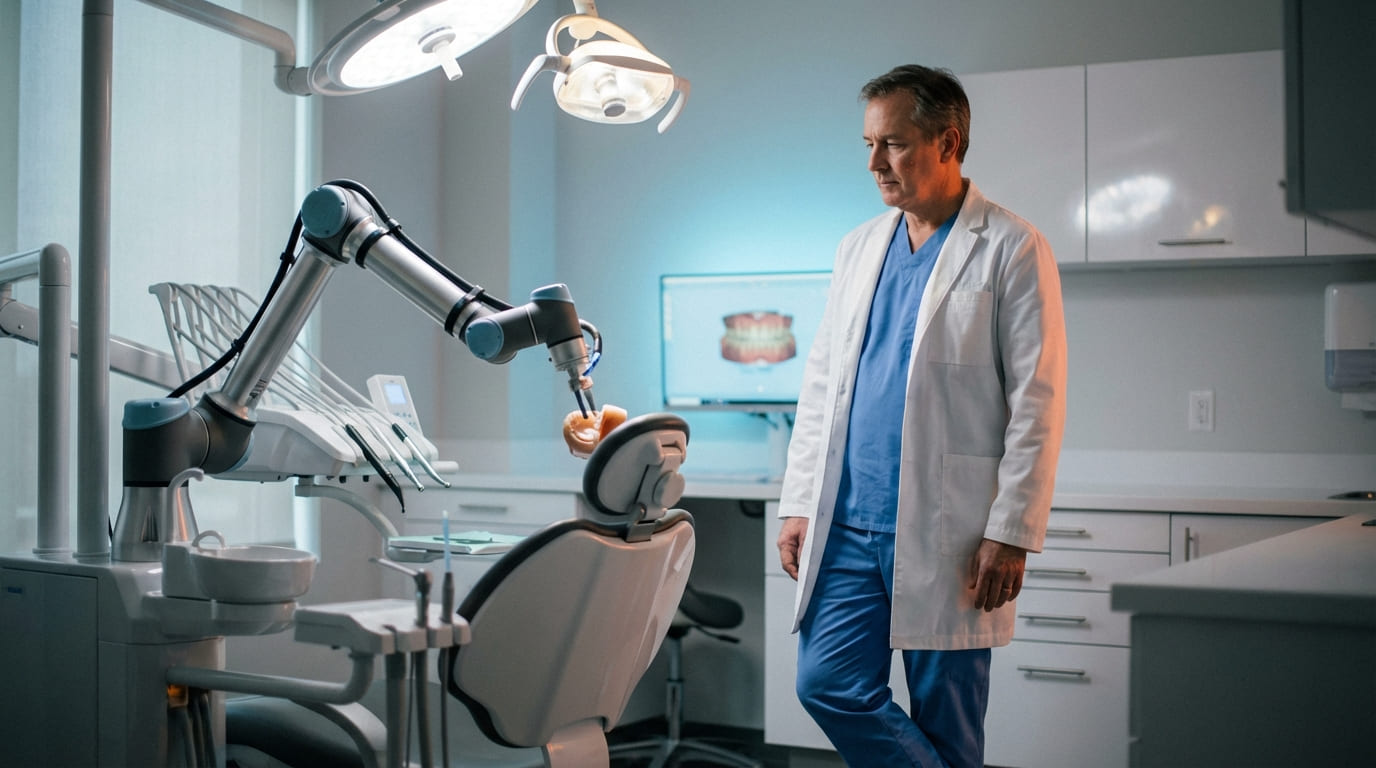
In July 2024, a company called Perceptive completed the world’s first fully autonomous dental procedure on a human patient. A crown prep, done entirely by a robot, in about fifteen minutes, when the same procedure normally takes two hour-long appointments. My first reaction was mild panic about job security, but my second reaction was more considered and I think more interesting.
How it works
The system uses a handheld 3D scanner built on optical coherence tomography to map the mouth, not just the surface but beneath the gumline and under the enamel. From that 3D model the AI plans the preparation, and a robotic arm carries it out. Perceptive claims over 90% caries detection accuracy with this imaging, compared with roughly 40% from conventional radiographs, and it does it without ionising radiation. Both the World Economic Forum and New Atlas covered it as a significant milestone in medical robotics.
What interests me
Fifteen minutes instead of two hours changes practice economics and patient experience simultaneously, and that caught my attention straight away. Crown prep quality varies enormously between clinicians, so a system that delivers a reliable, consistent prep every time could raise the baseline standard considerably. And if the OCT imaging proves dependable at scale, we get radiation-free 3D diagnostics, which is a proper step forward.
Where I actually land on this
Someone still has to consent the patient, take the history, decide whether a crown is even the right treatment, manage complications, and take responsibility for the outcome. That someone is a dentist. A robot can prep a tooth, but it cannot decide whether the tooth should be prepped.
Dentistry carries a tremendous amount of responsibility. When something goes wrong mid-procedure, whether it’s an unexpected pulp exposure or a distressed patient, someone has to make a judgement call in the moment, and you can’t programme that into a robotic arm. I see this as AI being an adjunct to a skilled clinician, not a replacement for one. The dentists who should be paying attention are those who define themselves purely by the mechanical work, because if all you bring is the ability to prep and restore, a machine may eventually do that part faster. But diagnosis, treatment planning, communication, long-term care: that’s the job, and it isn’t going anywhere.
The reality check
This was one procedure, on one patient, in Colombia. There’s no peer-reviewed clinical data yet and no FDA clearance, which is estimated to be about five years away. The company has $30 million in funding, including from Edward Zuckerberg (Mark’s father, who is a dentist) and PDS Health, one of the largest US dental chains. That’s serious backing, but backing and clinical validation are different things.
I’ve seen enough promising dental tech quietly disappear to know that a proof-of-concept is just the beginning. The distance between “it worked once” and “it works reliably in a busy practice on a Tuesday afternoon” is vast, and I’ll be watching with interest rather than alarm.
References
-
Perceptive. (2024). “Perceptive Completes World’s First Fully Automated Dental Procedure on a Human.” BusinessWire
-
World Economic Forum. (2024). “First fully automated dental surgery completed by robot.” WEF Stories
-
Blain, L. (2024). “Fully-automatic robot dentist performs world’s first human procedure.” New Atlas