Who's Funding the Robot Dentist?
 Ali Vatan
 Perceptive just raised $30 million for autonomous dental robotics. The investors include Mark Zuckerberg's father and one of America's largest dental chains.
Perceptive, a Boston-based startup, just raised $30 million to build an AI-driven robotic dentistry system, and the investors are what caught my attention: PDS Health (one of the largest dental support organisations in the US), Y Combinator, and Dr Edward Zuckerberg, Mark Zuckerberg’s father, who is himself a practising dentist (STAT News, 2024).
I want to say something that might make a few colleagues uncomfortable: there will come a time when robots can do certain things better than human hands can. In dentistry. On your patients. The money flowing into this space tells me I’m not alone in thinking so.
What Perceptive is building
They’re not making a single device. They’re building an integrated system that covers the full clinical workflow, combining a handheld imaging device, an AI algorithm for diagnosis and treatment planning, and a robotic arm to carry out the procedure. In July 2024 they completed the world’s first fully automated dental procedure on a human patient, a crown preparation and placement done in roughly fifteen minutes (BusinessWire, 2024). Compare that to the two separate appointments we’d typically need: fifteen minutes, one visit, no impressions, no temporaries, no second appointment.
Is it ready for mainstream clinical use? Not yet. But the direction is unmistakable.
The timeline matters less than the trajectory
Maybe it’s five years away, maybe ten, but a robotic system that can analyse a thousand cases, process imaging data in milliseconds, and execute a preparation with sub-millimetre precision will eventually outperform human hands on certain tasks. That’s not a slight against dentists; it’s just physics and computation.
If AI can think, analyse, and store information a million times faster than we can, and if it can perform repetitive physical tasks with greater consistency, where does that leave us? I think the answer is hopeful.
The human part stays human
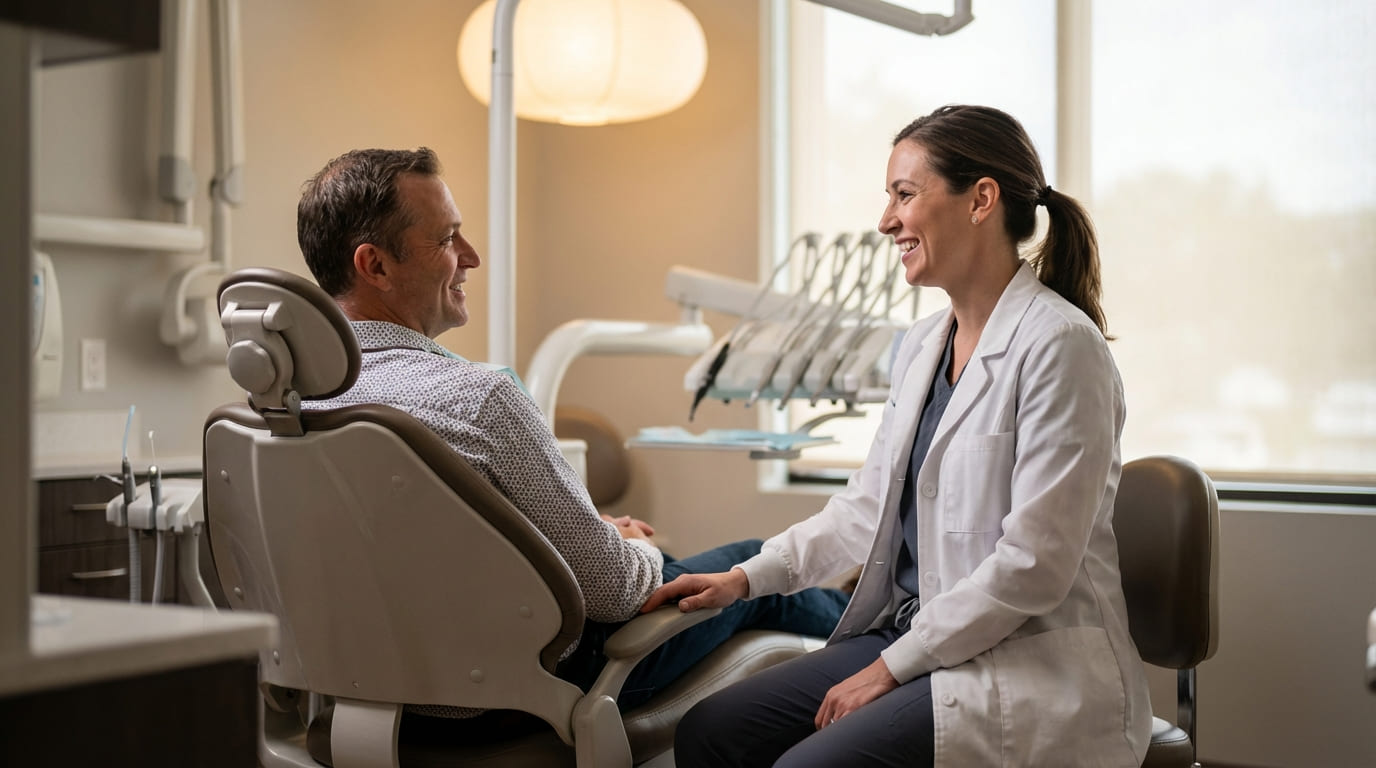
A robot will never sit with a nervous patient and talk them through their fear of needles, and it won’t build a relationship with a family over fifteen years, or notice that someone seems a bit down and ask if they’re alright. We build trust through eye contact, tone of voice, shared history. In a world where robots handle the technically repetitive parts of clinical care, clinicians are freed up to focus on the things that matter most to patients: relationships, trust, communication, and the experience of receiving care.
I see AI as something that will handle the chores, and that should be liberating rather than threatening.
Why the investor list matters
PDS Health operates over 900 dental offices across the United States. They’re not investing because it sounds futuristic; they can see the operational reality, because a system that reduces chair time, improves consistency, and streamlines workflows has enormous value when you’re managing hundreds of clinicians (Perceptive/TSV Capital, 2024).
Ed Zuckerberg isn’t just a famous surname. He’s been practising dentistry for decades, and his involvement tells me someone who understands the clinical side looked at this technology and thought: this is real. Y Combinator doesn’t back vanity projects either; their portfolio includes Airbnb, Stripe, and Dropbox, so they back companies they believe will define industries.
These aren’t naive tech investors chasing a buzzword. These are people who understand dental workflows, dental economics, and what it takes to treat a patient.
What this means for us
The dentists who will thrive in this landscape are the ones who lean into what makes them irreplaceable: clinical judgement in complex cases, patient relationships, ethical decision-making, empathy, and leadership. The technical execution of a crown prep might well become automated, but the decision about whether a crown is the right treatment in the first place remains deeply human. This funding round is a signal that the next wave of AI in dentistry won’t just be software on a screen; it will be physical systems in the surgery, and I think the profession needs to be ready for that conversation.
References
-
STAT News. “Dental AI startup raises $30 million, including from Mark Zuckerberg’s dad.” July 2024. https://www.statnews.com/2024/07/30/dental-ai-robotics-startup-perceptive-ed-zuckerberg/
-
BusinessWire. “Perceptive Completes World’s First Fully Automated Dental Procedure on a Human Using AI-Driven Robotic System.” July 2024. https://www.businesswire.com/news/home/20240730980575/en/Perceptive-Completes-Worlds-First-Fully-Automated-Dental-Procedure-on-a-Human-Using-AI-Driven-Robotic-System
-
TSV Capital. “Perceptive Dental Robotics System: Revolutionizing Precision and Efficiency in Dentistry.” 2024. https://www.tsvcap.com/post/perceptive-dental-robotics-system-revolutionizing-precision-and-efficiency-in-dentistry
-
Newsweek. “Watch: AI Robot Dentist Performs Human Dental Crown in Minutes.” 2024. https://www.newsweek.com/ai-robot-dentist-performs-human-dental-crown-minutes-1932997